he Stability of Stacks: Why Absolute Positioning Fails
Why "dragging and dropping" creates fragile websites, and how the Flexbox model ensures digital resilience across every device.
Date
Category
Writer
The Illusion of Freedom
In traditional graphic design tools, you can place an image anywhere on the canvas. It stays there. But the web is fluid. A screen can be 300 pixels wide or 3000.
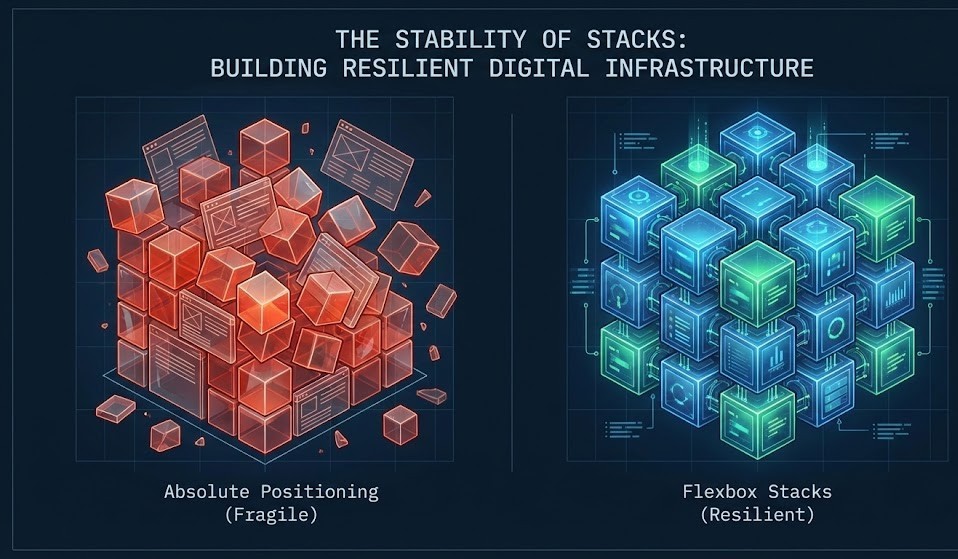
When designers use "Absolute Positioning" (dragging elements freely), they are building a house of cards. As soon as the browser window resizes, elements overlap, text cuts off, and the layout drifts. This is the "Floating Ghost" effect.
The Engineering Solution: Flexbox Stacks
At Svarog, we don't just place elements; we structure them. We use Stacks (based on CSS Flexbox).
Relationship: Elements are aware of their neighbors. If one paragraph grows, the footer pushes down automatically.
Constraints: We define rules (Fill, Fit, Fixed) rather than coordinates.
Resilience: The layout adapts to the content, ensuring the site remains functional whether viewed on an iPhone SE or a 4K monitor.
We don't build paintings. We build flexible, resilient systems.
Thoughts, ideas, and perspectives on design, simplicity, and creative process.